I get the same question almost every week: “John, how much is this deck repair going to run me?” And honestly, I understand why people ask before they pick up a phone. Deck work is one of those projects where the price tag swings wildly depending on what’s actually wrong underneath those boards.
So here’s the straight answer based on what I see across Atlantic County every year — what real homeowners pay, what drives those numbers up or down, and the small choices that save you a few thousand dollars (or cost you everything if you skip them).
I’m John, owner of Mackenzie Contracting LLC out of Egg Harbor Township, NJ HIC #13VH12847300. This guide is the same conversation I have on free estimates, just written down.
Average Deck Repair Cost in Atlantic County, NJ
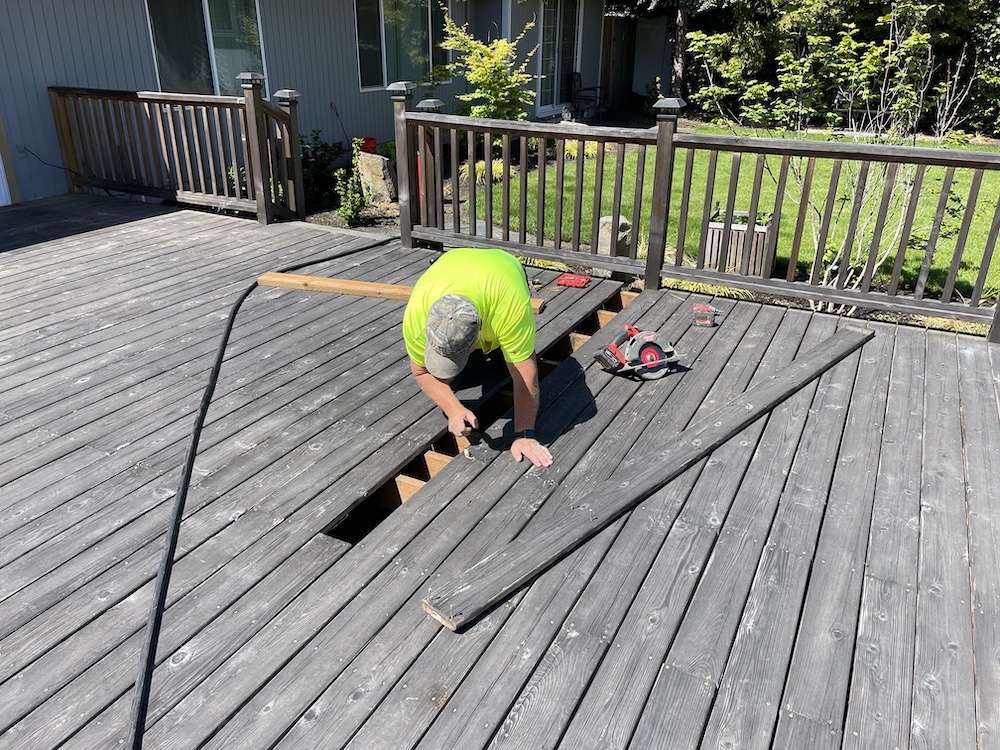
Deck repair in Atlantic County, NJ typically costs $400 to $8,500, with most single-component jobs landing somewhere between $1,200 and $3,800.
A small board swap on a back-porch deck behaves nothing like a ledger reflash on a second-story deck overlooking the bay — and the price reflects that gap.
Cost by Project Scope (Quick Reference Table)
| Repair Scope | Typical Cost Range | What’s Included |
|---|---|---|
| Minor surface repair | $400 – $900 | A few rotted boards, loose railing posts, popped fasteners |
| Mid-scope repair | $1,200 – $3,800 | Multiple boards, baluster work, stair tread replacement, partial re-stain |
| Structural repair | $2,500 – $6,500 | Ledger reflash, joist sistering, post base replacement, hardware upgrades |
| Heavy structural + cosmetic | $5,500 – $8,500 | Full deck strip, frame repair, all new boards, code-compliant railing |
| Full re-deck (250–400 sq ft) | $8,000 – $18,000 | Complete tear-down and rebuild on existing footings |
These ranges cover labor and materials together, the way most homeowners want to see them.
Cost Per Square Foot — Repair vs. Re-Deck
For benchmarking, deck repair in Atlantic County runs $8 to $30 per square foot depending on what gets touched. A full re-deck — meaning everything above the joists comes off and gets replaced — costs $30 to $60 per square foot, with composite and PVC pushing the top end of that.
A 280-square-foot deck (a common size for split-levels and ranches across Egg Harbor Township and Galloway) lands in this neighborhood:
- Surface board replacement only: $2,200 – $8,400
- Boards plus railing rebuild: $5,000 – $12,000
- Full re-deck on sound joists: $8,400 – $16,800
- Re-deck plus joist and post work: $11,000 – $20,000
Why Atlantic County Decks Cost More to Repair Than Inland NJ
A deck on the barrier islands lives a harder life than a deck twenty miles inland. Salt fog, marine humidity, and tide-driven moisture cycling drive corrosion and fungal decay at a faster rate — particularly at metal connectors, post bases, and end-grain cuts.
That accelerated wear shows up in two places on your invoice: more frequent repair intervals and a hardware premium for stainless or hot-dipped galvanized fasteners rated for coastal exposure.
A deck in Margate, Ventnor, Longport, or Brigantine almost always justifies the upgraded hardware. A deck inland in Hamilton or Hammonton can often run standard galvanized and last just as long. That single material decision moves the bottom line by 15 to 30 percent on the connector portion of the job.
Itemized Deck Repair Costs by Component
Six components account for the overwhelming majority of deck repair invoices in Atlantic County: deck boards, ledger boards, joists, post bases, railings, and stairs. Knowing what each one costs in isolation makes any estimate easier to read.
Deck Board Replacement Cost (Pressure-Treated, Cedar, Composite)
Board replacement cost depends on three things: the species, the length, and how badly fastener corrosion has chewed up the joists underneath.
| Decking Type | Cost Per Board (Installed) | Notes |
|---|---|---|
| Pressure-treated pine (5/4×6×12) | $25 – $60 | The default for South Jersey; resists rot well when properly sealed |
| Western red cedar | $40 – $90 | Naturally rot-resistant; common on older Linwood and Northfield decks |
| Composite (Trex, TimberTech, Fiberon) | $60 – $120 | Higher upfront, lower lifetime maintenance |
| PVC capstock | $80 – $140 | Best for direct salt exposure; common in Margate and Brigantine rebuilds |
Board cost looks simple on paper. The hidden cost is what we call “carrying repair” — when the screws are corroded into the joist and the board splits during removal, the joist top often takes damage too. Plan for an extra 5 to 15 percent on any pre-2010 deck for incidental repair during board swaps.
Ledger Board Repair Cost
Ledger board repair runs $750 to $3,000 in Atlantic County, and it’s worth every dollar. The ledger is the horizontal board that bolts your deck to the house, and failed flashing at the ledger is the single most common cause of structural deck failure.
When water sneaks behind that flashing, it rots the rim joist of the house, the band joist, and the ledger itself — usually with zero visible warning above the deck surface.
A real ledger repair includes pulling the existing ledger, inspecting and treating the rim joist behind it, installing new code-compliant flashing (drip-edge plus Z-flashing minimum), bolting in a new ledger with structural lag screws or through-bolts, and reattaching joist hangers.
Anything cheaper than that is cosmetic — somebody slapped a board on the wall and called it done
Joist & Beam Repair Cost
Sistering a damaged joist costs $150 to $400 per joist. Sistering means we bolt a fresh joist alongside the failing one, transferring the load while leaving the old framing in place.
On a typical Atlantic County deck with 8–12 joists at 16-inch on-center spacing, a meaningful joist repair lands in the $1,200 to $4,000 range.
Beam-to-post connection repairs cost $300 to $900 per connection point, depending on whether we’re replacing post caps, retrofitting hurricane ties, or rebuilding the entire bearing assembly.
On older decks built before the 2009 IRC connector requirements, hardware retrofits often turn into a series of upgrades at every joist hanger and post cap. The deck ends up safer than it was new — and the invoice reflects that depth of work.
Post Base & Footing Repair Cost
Post base replacement runs $200 to $600 per post with standard galvanized hardware, and $350 to $900 with stainless coastal-grade connectors.
Cracked or heaved footings push the cost higher because we have to demo the existing concrete, dig down below the frost line (NJ frost depth is roughly 36 inches), pour new footings, and let them cure before resetting hardware.
Watch for orange staining at the base of any post — that’s rust bleed from corroded post-anchor hardware, and it’s the most reliable visual sign that the connection underneath has failed.
Railing & Baluster Repair Cost
Railing repair costs $35 to $95 per linear foot, depending on whether we’re tightening posts and replacing balusters or rebuilding the entire system code-compliant.
NJ adopts the IRC requirement that decks more than 30 inches above grade carry railing at minimum 36 inches in height, with balusters spaced so a 4-inch sphere cannot pass through.
A loose top rail almost always traces back to a railing post that isn’t properly anchored to a rim joist or blocking. We don’t tighten loose rails — we re-anchor them through to structural framing, because a railing that holds up to one shoulder check but fails under three people leaning on it is worse than no railing at all.
Stair & Stringer Repair Cost
Replacing a single stair stringer costs $200 to $500, and a full set of stairs (3–5 steps with stringers, treads, and risers) runs $800 to $2,500.
Stair stringers rot from the bottom up because the bottom-most cut sits closest to the ground and traps moisture against end grain. If your stairs feel bouncy or one tread sounds different from the others when you walk down, the stringers are usually the culprit.
Deck Staining and Sealing Cost
Staining and sealing costs $2.50 to $5.00 per square foot in Atlantic County, with most homeowners on a 250–400 square foot deck spending $700 to $2,000 for a quality job.
The price covers cleaning, sanding any rough spots, replacing failed nails or screws, and applying a stain or sealer rated for marine environments. In coastal towns, that re-seal cycle runs every 24 to 36 months; inland, you can stretch to 4 years.
For homeowners pricing exterior maintenance as a package, deck sealing pairs naturally with full-house exterior work — see our Painting Services in South Jersey NJ for combined estimates.
7 Factors That Change Deck Repair Cost in Atlantic County
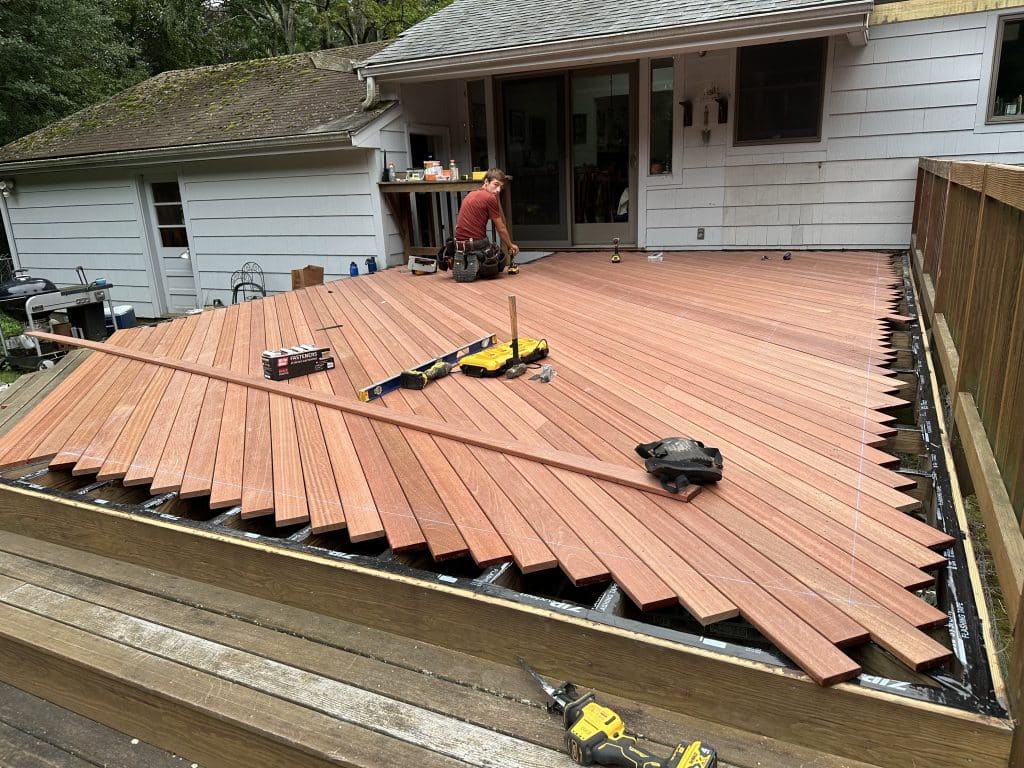
Seven variables move deck repair cost up or down by 15 to 60 percent in Atlantic County: salt air exposure, decking material, deck size, damage extent, permit requirements, site access, and contractor license status.
1. Coastal Salt Air & Hardware Corrosion Premium
Salt air drives a cost premium on connectors, fasteners, and post anchors. Hot-dipped galvanized hardware costs roughly 30 to 50 percent more than standard zinc-coated. Stainless steel coastal hardware costs 2 to 3 times more than standard.
On a deck with 12 joist hangers, 6 post bases, and 200 fasteners, that’s a real number — but the salt-rated hardware lasts decades longer in barrier-island conditions. Margate, Ventnor, Longport, and Brigantine almost always justify the upgrade.
2. Decking Material
Pressure-treated pine is the cheapest to repair because the lumber is widely stocked and individual boards swap out cleanly. Composite decking costs more per board but rarely needs replacement once installed correctly.
Cedar sits in the middle — beautiful, naturally rot-resistant, but slowly disappearing from the market as composite takes over. Mixing materials on a single deck (composite boards on a pressure-treated frame) is normal and doesn’t change repair cost much.
3. Deck Size and Height Above Grade
A larger deck costs more, obviously. A higher deck costs more per square foot than a low one. Anything more than 30 inches above grade triggers railing requirements; anything more than 6 feet above grade brings additional structural review.
Multi-level decks add complexity at the transitions between levels — that’s where ledger boards, double rim joists, and structural beams stack up, and that’s where repair cost compounds.
4. Extent of Structural Damage
Cosmetic damage — splintered boards, peeling stain, surface cracking, loose railing — runs at the cheaper end. Structural damage — rotted ledger, sistered joists, corroded post bases, cracked footings — runs at the higher end.
The single best signal is how the deck feels underfoot. A deck that bounces noticeably with each step has joist deflection issues, and joist work moves the invoice into the structural tier.
5. Permit Requirements and Inspection Costs in Atlantic County
Atlantic County deck permits typically cost $50 to $300 depending on the municipality and the scope of work. Surface board replacement usually does not require a permit. Structural work — ledgers, joists, posts, footings, railings — usually does.
Each Atlantic County municipality (Egg Harbor Township, Margate, Ventnor, Brigantine, Galloway, Hamilton, and the rest) operates under the NJ Uniform Construction Code, but local permit fees vary. The local building department gives you the exact number in about ten minutes by phone.
6. Access, Demolition, and Disposal Fees
A second-story deck on a lot with no rear-yard access costs more to repair than a ground-level back porch with a driveway twenty feet away.
Carry-in carry-out adds labor hours. Dumpster rental and disposal of treated lumber adds $300 to $800 on bigger jobs. On the barrier islands, parking access during summer months adds time on its own.
7. Contractor License Status (Licensed NJ HIC vs. Unlicensed)
Hiring an unlicensed contractor saves money on the front end and costs everything on the back end. New Jersey requires a Home Improvement Contractor (HIC) registration for any home improvement project over $500.
An unlicensed contractor cannot legally pull permits, carries no insurance you can rely on, and gives you no recourse if the work fails an inspection or causes injury. The premium on a licensed NJ HIC contractor is often 10 to 25 percent, and it’s the cheapest insurance policy you’ll ever buy on a deck.
Deck Repair vs. Full Replacement — When the Cost Math Changes
Full deck replacement makes more sense than repair when more than 40 percent of deck boards need replacement, when the ledger board has failed, when multiple post bases show structural corrosion, or when the deck is more than 25 years old without documented maintenance history.
The 40% Rule for Board Replacement
Here’s how I explain the 40 percent rule on every estimate. If you replace fewer than 40 percent of the boards on a deck, the new boards weather differently from the old, you get a patchwork color, and you still pay full mobilization costs to come back when the next round of boards fails.
If you replace more than 40 percent, you’re past the break-even — re-decking the whole surface costs only a little more than partial replacement, gives you uniform weathering going forward, and lets us inspect and upgrade every joist, hanger, and ledger connection while the surface is open.
A Real Atlantic County Example — 280 sq ft Deck in Somers Point
Take a real-world case. A 280-square-foot deck in Somers Point with 110 square feet of damaged boards (about 39 percent of the surface) and otherwise sound framing:
- Partial repair option: Replace 110 sq ft at $25/sq ft installed = $2,750, plus a re-stain on the entire deck for color match at $3.50/sq ft = $980. Total: $3,730.
- Full re-deck option: Tear off 280 sq ft, inspect framing, re-fasten with new structural screws, install all new pressure-treated boards at $35/sq ft installed = $9,800.
The partial repair wins on price today. But that deck is back on my call list in 2–4 years for the next round of boards. The full re-deck wins on a 15-year horizon. Which option fits depends on how long the homeowner plans to stay in the home.
Structural Failure Indicators That Force Replacement
Some conditions take repair off the table entirely. Cracked or heaved concrete footings, multiple rotted joists, a ledger board that’s separated from the house wall, a deck frame that visibly tilts or sags under no load — these aren’t repairs, they’re rebuilds. A deck that fails any of these tests needs to come down and go back up on new footings.
Deck Permit Cost and Code Requirements in Atlantic County, NJ
Atlantic County deck permits cost $50 to $300 depending on the project value and the municipality. Permits are required for any structural repair affecting ledgers, joists, posts, footings, or railings — surface board replacement alone typically does not trigger a permit.
When Repairs Trigger a Permit (And When They Do Not)
Permit-required work includes ledger replacement, joist sistering or replacement, post or footing work, railing height changes, and any expansion of the deck footprint.
Permit-exempt work usually includes board replacement, baluster replacement (without changing height), stair tread replacement, and re-staining or re-sealing.
The grey area is where homeowners get into trouble. Replacing a single rotted joist looks like a small job, but it’s structural, and an inspector who sees that work uncovered later (during a future inspection or a real estate transaction) can flag the entire deck.
NJ Code Requirements That Affect Repair Cost
Three code items consistently affect repair cost in Atlantic County:
- Railing height — 36 inches minimum when the deck surface is more than 30 inches above grade.
- Baluster spacing — A 4-inch sphere cannot pass through any opening in the railing system.
- Connector requirements — Modern code requires hurricane ties at every joist-to-beam connection and post bases approved for the wood-to-concrete connection.
Older decks (pre-2009) often miss all three. Bringing them up to current code during a repair adds cost — but it’s the difference between a deck that passes inspection and a deck that doesn’t.
Deck Repair Cost for Rental and Vacation Properties
Rental property deck repairs typically run 10 to 20 percent higher in documented cost because landlords need written structural reports for liability files, insurance documentation, and property management records. That’s not a markup — it’s a different scope of deliverable.
Landlord Liability and Documented Repair Cost Premium
A landlord in New Jersey carries direct liability for structural deck failure that injures a tenant or guest. The deck doesn’t have to look bad to fail — a perfectly clean composite surface over a rotted ledger board is a liability waiting for a heavy summer party.
The way landlords protect themselves is documented structural assessment, documented repair, and written certification of the work — kept on file before anything happens.
For vacation rental and Airbnb owners specifically, that documentation matters even more during peak booking season. A guest injury claim against a short-term rental host is harder to defend without a recent structural report on file.
We provide written deck repair documentation for property management records as part of our Rental Property Maintenance Services in NJ.
Atlantic County Short-Term Rental Deck Repair Considerations
Coastal short-term rentals carry one extra problem inland rentals don’t: high-traffic decks during a 12-week summer window. A deck that holds up fine for a single family using it twice a week behaves differently when 30 different guests use it across June, July, and August.
We schedule rental deck assessments for spring (before booking season) and again in early fall (before winter weather settles in).
How to Reduce Deck Repair Cost Without Cutting Corners
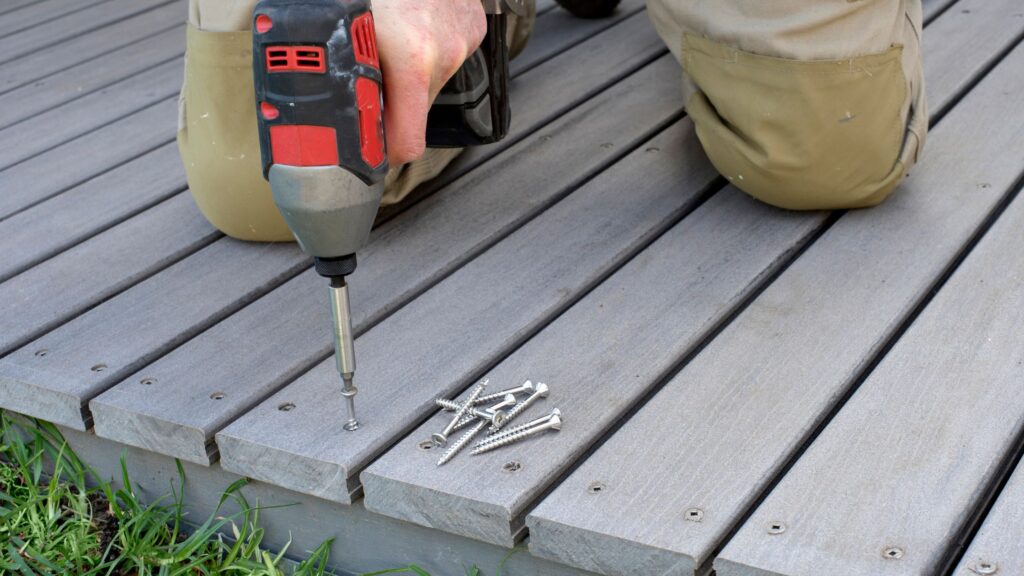
Three preventive practices reduce lifetime deck repair cost by 40 to 60 percent: annual structural inspection, immediate flashing repair at the ledger, and re-sealing every 24 to 36 months in coastal Atlantic County.
Catch Wood Rot Early — The Screwdriver Probe Test
The single best diagnostic for catching deck rot before it costs real money is the screwdriver probe test. Take a flat-head screwdriver, push it with firm hand pressure into the wood at four critical spots: the ledger board (where the deck meets the house), the post bases (where vertical posts meet concrete or hardware), the rim joist (the outermost framing member), and the stair stringers (where the bottom step meets the ground).
Sound wood resists. Soft, “punky” wood lets the screwdriver sink in with little resistance — that’s active fungal decay, and it spreads outward into adjacent framing if left alone.
Catching rot at the screwdriver-probe stage usually means a $300 board replacement. Catching it after the joist hanger pulls free of the rotted joist usually means a $3,000 structural repair.
Annual Inspection and Preventive Maintenance Cost
A professional deck inspection in Atlantic County runs $150 to $400 and takes about an hour for a typical residential deck. That fee covers a structural walk-through, screwdriver probe testing at all the critical points, hardware and fastener inspection, railing load testing, and a written report.
Run that inspection once a year on any deck more than five years old, and you catch problems while they’re cheap.
How to Choose a Licensed Deck Repair Contractor in Atlantic County, NJ
Three vetting steps separate a legitimate Atlantic County deck contractor from a liability risk: verify the NJ HIC license number on the state portal, confirm bonded and insured status in writing, and require a structural assessment before any price is quoted.
Verifying NJ HIC License (#13VH...)
Every legitimate New Jersey home improvement contractor carries a license number that starts with 13VH. You can verify any license in about 30 seconds at the New Jersey Division of Consumer Affairs licensing portal.
Mackenzie Contracting LLC carries NJ HIC #13VH12847300 — that number appears on every estimate, every invoice, and every contract we send out.
If a contractor refuses to give you a license number, ask once, then move on. If they give you a number that doesn’t appear on the state portal, run.
Red Flags in a Deck Repair Estimate
Watch for five red flags on any deck repair estimate:
- No structural assessment. A contractor who quotes a price without crawling under the deck or probing the ledger is quoting cosmetic work on what may be a structural problem.
- Cash-only with no contract. Legitimate NJ contractors operate on written contracts. Cash-only side-deals are a tell.
- Pressure to start tomorrow. “We have a crew in the area today only” is a sales tactic, not a scheduling reality.
- No license number in writing. Verbal confirmation isn’t a license.
- A price wildly below other bids. Three bids that come in within 15 percent of each other tell you the market price. A bid that’s 40 percent under is either missing scope, missing materials, or missing the license to do the work properly.
What a Free Structural Assessment Should Include
A real free structural assessment includes a visual walk-through of the deck surface, screwdriver probe testing at the ledger and post bases, inspection of joist hangers and post anchors from underneath the deck, a check of railing rigidity and baluster spacing, and a written summary of what’s structurally sound and what isn’t.
The price comes after that assessment — never before. Schedule a free structural deck assessment before you sign anything.
Frequently Asked Questions About Deck Repair Cost in Atlantic County
How much does deck repair cost in Atlantic County, NJ?
Deck repair in Atlantic County costs $400 to $8,500 for the typical project, with most single-component repairs landing between $1,200 and $3,800. Cost depends on scope, materials, and whether the damage is cosmetic or structural.
Is deck board replacement cheaper than full re-decking?
Board replacement is cheaper when fewer than 40 percent of the deck surface needs replacement. Past that threshold, full re-decking costs only modestly more and gives uniform weathering across the entire deck.
How much does it cost to fix a rotted ledger board?
Ledger board repair in Atlantic County costs $750 to $3,000, depending on the extent of rot in the rim joist behind the ledger and whether new flashing and structural fasteners are required.
Do I need a permit to repair a deck in Atlantic County?
Surface board replacement and re-staining typically do not require a permit. Structural work — ledgers, joists, posts, footings, and railings — typically does. Atlantic County permit fees range from $50 to $300 depending on the municipality.
How much more does deck repair cost on the barrier islands?
Decks in Margate, Ventnor, Longport, and Brigantine often justify a 15 to 30 percent premium on connector hardware (stainless or hot-dipped galvanized) compared to inland Atlantic County. The hardware lasts decades longer in coastal salt exposure.
How long does deck repair take?
Board and railing repairs typically complete in one day. Structural joist or ledger work runs one to three days depending on scope. Full re-decking takes two to four days.
What is the average cost to repair a deck railing per linear foot?
Railing repair costs $35 to $95 per linear foot in Atlantic County, depending on whether the work involves tightening posts, replacing balusters, or rebuilding the system to current NJ code (36-inch minimum height when the deck is more than 30 inches above grade).
Does my homeowners insurance cover deck repair in NJ?
Most NJ homeowners policies cover sudden damage (a tree falling on the deck) but exclude wear-and-tear or rot-driven structural failure. Check your policy declarations or call your carrier — coverage varies by policy.
How do I verify an NJ deck contractor is licensed?
Search the New Jersey Division of Consumer Affairs licensing portal using the contractor’s HIC number (starts with 13VH). Mackenzie Contracting LLC is registered as NJ HIC #13VH12847300.
Get a Free Deck Repair Estimate in Atlantic County, NJ
Every deck I look at gets a free structural assessment before any price comes out — ledger, joists, post bases, railing, stairs, the whole frame. Cosmetic repairs on a compromised structure are a safety problem, not a savings.
If you’re in Egg Harbor Township, Northfield, Linwood, Somers Point, Margate, Ventnor, Brigantine, Galloway, Hamilton, Mays Landing, or anywhere else in Atlantic and Cape May counties, I can be on the property within a few days.
📞 Call (609) 412-7764 or Request a Free Estimate online.
Mackenzie Contracting LLC — Licensed, Bonded, Insured | NJ HIC #13VH12847300 | Egg Harbor Township, NJ.